
astrology
which zodiac sun signs get along with others?
1 min read→

Vimshottari vs Yogini Dasha: Which One Actually Tells You When You'll Get Married?
If you've ever asked an astrologer "when will I get married?", chances are they pulled up your Vimshottari Dasha. It's the default timing system in Vedic astrology, and for good reason — it's detailed, well-documented, and built to map your entire life, not just one event.
But there's a second, lesser-used system that many serious astrologers quietly rely on to sharpen that answer: Yogini Dasha. On its own, it rarely gets the spotlight. Paired with Vimshottari, it often turns a vague "sometime in the next few years" into a much narrower window — and it's especially useful when two charts are being matched for marriage, not just one.
Here's how the two systems actually work, and how they come together for marriage timing and match-making.
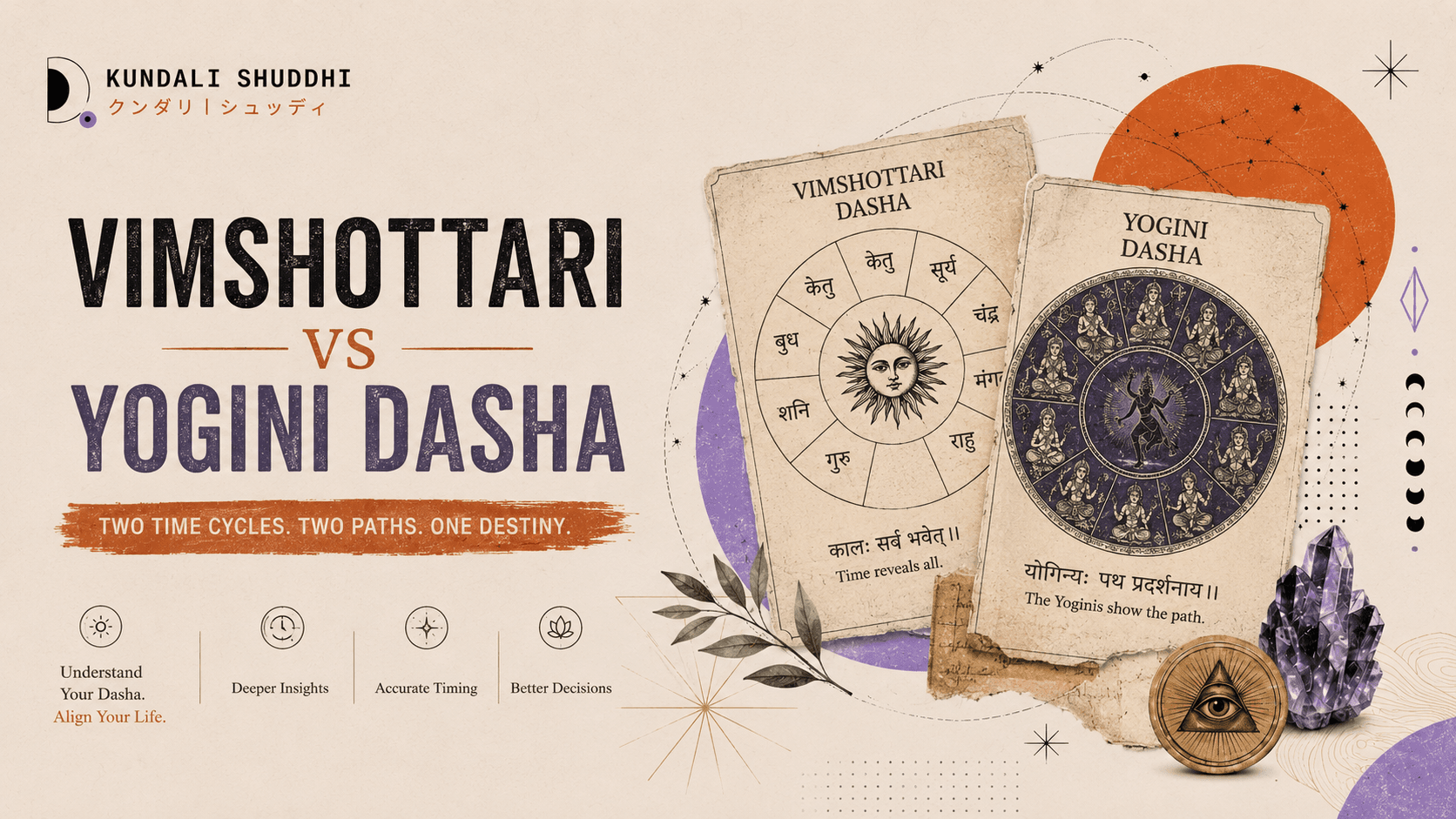
Vimshottari is a 120-year planetary cycle calculated from the Moon's nakshatra at birth, divided across the nine grahas — Sun, Moon, Mars, Rahu, Jupiter, Saturn, Mercury, Ketu, and Venus. Each planet governs a Mahadasha (major period) lasting anywhere from 6 to 20 years, which is then broken down into Antardashas (sub-periods) and further into Pratyantardashas.
This is the system astrologers reach for first because it's comprehensive: career shifts, marriage, health, finances, and major turning points all show up somewhere in its layered structure.
For marriage specifically, the system looks at:
The strongest predictions come from intersections — when the Mahadasha lord, the Antardasha lord, and the transiting influences of Jupiter and Saturn all point toward the same house at the same time. That's when astrologers say the marriage window narrows from "a few years" down to a specific season.
Yogini Dasha compresses the same idea into a 36-year cycle, governed by eight Yoginis — feminine cosmic principles, each carrying its own emotional and karmic flavor, tied to a planetary energy.
Because the cycle is so much shorter than Vimshottari's 120 years, each Yogini period moves faster and reads more like a "mood" or "trigger phase" than a life chapter. This is exactly why it's useful for marriage timing: it's less about whether marriage is destined, and more about when the emotional and karmic conditions are actually ripe for it.
A few patterns astrologers commonly watch for:
None of this replaces Vimshottari. It sits alongside it, adding texture to how a marriage period is likely to feel — smooth, delayed, sudden, or karmically loaded — rather than just confirming that one is coming.
Marriage timing gets more complex the moment a second chart enters the picture, which is exactly what happens in kundli matching.
It's not enough for one partner to be running a favorable Venus or Jupiter period. A well-matched window typically requires:
This is precisely why serious kundli milan goes beyond a guna-matching percentage. The percentage tells you if two charts are compatible in principle. The Dasha overlay tells you if now — or six months from now, or next year — is actually the right window for both people.
In theory, all of this is calculable from a birth chart. In practice, it means tracking two separate multi-planet cycles, cross-referencing them against the 7th house, Venus, Jupiter, Rahu, and each Yogini's karmic signature — for two people at once — and then checking for Sandhi conflicts on both sides. Most manual readings stop at Vimshottari alone, simply because layering in Yogini Dasha and doing it for both partners is time-consuming to do correctly.
At Kundali Shuddhi, our AI-powered Dasha engine runs the full analysis for you — mapping your Vimshottari and Yogini Dasha periods together, flagging marriage-supportive windows, and cross-checking Sandhi transitions so you're not left guessing at a single percentage score.
If you're trying to figure out when marriage is likely, or you want to check whether your and your partner's timing genuinely aligns, try our Dasha feature to get a clearer, more accurate picture of your most suitable window — before you fix a date.
Subscribe to our newsletter for cosmic drops.

READY FOR PERSONALIZED INSIGHTS